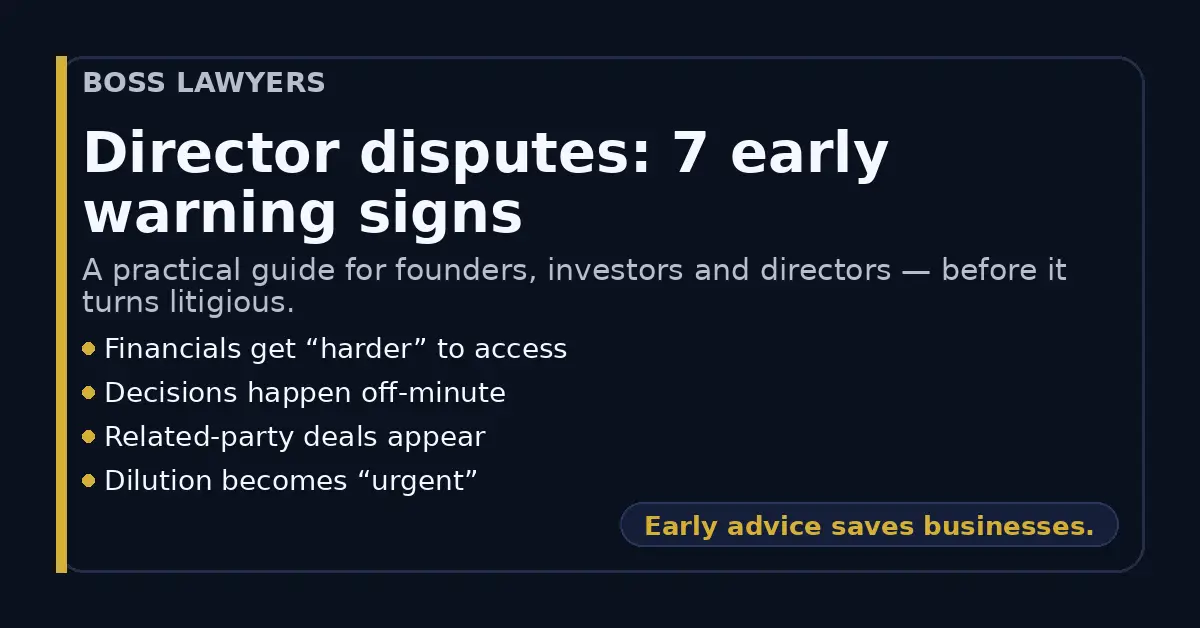
- Shareholder disputes in Queensland are resolved under the Corporations Act 2001 (Cth), primarily via s 232 (oppression remedy) and s 461 (just and equitable winding up)
- Most disputes are resolvable without litigation — but only if legal advice is obtained early, before positions harden
- A shareholder dispute lawyer can advise on your rights, negotiate a buyout, seek urgent injunctive relief, or commence court proceedings
- The cost of delay typically exceeds the cost of early advice — disputes escalate faster than business owners expect
- Boss Lawyers regularly acts in shareholder disputes across Queensland — call 1300 267 711 for a consultation
If something is going wrong with your co-shareholder relationship in a Queensland company, the question isn’t whether you need legal advice — it’s when. Most business owners wait too long. By the time they call a shareholder dispute lawyer, the relationship is irreparably broken, the other side has been taking advice for months, and the options that were available six months ago have narrowed significantly.
This guide covers the warning signs that tell you it’s time to get legal advice, what a shareholder dispute lawyer in Brisbane actually does, your options under Queensland law, and what to expect from the process.
What Is a Shareholder Dispute?
A shareholder dispute is any conflict between shareholders of a company — or between shareholders and the company’s directors — about the management, control, or value of the business. In private companies, these disputes are especially common because there is no ready market for shares: you cannot simply sell your stake if things go wrong. You are locked in.
Common triggers for shareholder disputes in Queensland include:
- Disagreement about business direction or strategy
- A co-shareholder who is also a director being excluded from management decisions
- Dividends not being declared, or being declared selectively
- Undisclosed related-party transactions — a director dealing with the company for personal benefit
- A breakdown of the personal relationship between co-founders or business partners
- A shareholder wanting to exit but being unable to agree on a price for their shares
- One shareholder being diluted through an unfair share issue
- Refusal to provide access to company books and financial records
Any of these situations can give rise to legal rights under the Corporations Act 2001 (Cth). Whether and when to exercise those rights is a matter of strategy — which is why early legal advice matters.
Signs You Should Call a Shareholder Dispute Lawyer
If you are experiencing any of the following, it is time to get advice from a shareholder dispute lawyer in Brisbane — not next month, now.
1. You are being excluded from the business
If you are a shareholder who is also a director, being removed from or locked out of management may constitute oppressive conduct under s 232 of the Corporations Act. The longer this continues without being addressed, the harder it becomes to establish a clean factual record.
2. Financial information is being withheld
Shareholders have statutory rights to inspect certain company records under the Corporations Act. If you are being denied access to financial statements, minutes, or the share register, a lawyer can seek an order compelling disclosure — or this conduct may itself support an oppression claim.
3. Dividends are not being paid — or are being paid selectively
If the company is profitable but dividends are not being declared, or if dividends are being paid to some shareholders but not others, this may be oppressive conduct. It is also a common pressure tactic used to force minority shareholders to sell at an undervalue.
4. You suspect related-party dealings
Directors who deal with the company on undisclosed terms — paying themselves excessive management fees, entering contracts with associated entities, or directing business to related parties — may be breaching their duties under ss 180–184 of the Corporations Act. This can ground both a director dispute claim and a shareholder oppression claim.
5. You cannot agree on share value for an exit
When one shareholder wants to exit but the parties cannot agree on the price for the departing shareholder’s interest, legal advice can help you understand your rights, the methods courts use to value shares in dispute, and whether a buyout order under s 233 is available.
6. There is a deadlock and the business cannot function
In a 50/50 company where neither shareholder can outvote the other, a genuine deadlock can paralyse the business. Courts have power to wind up companies on just and equitable grounds under s 461(1)(k) when a deadlock makes continued operation impossible — but this is a remedy of last resort. Earlier legal intervention often resolves deadlocks without winding up.
What Does a Shareholder Dispute Lawyer Do?
Engaging a shareholder dispute lawyer in Queensland is not the same as deciding to go to court. A good lawyer’s first job is to assess your position, explain your options, and identify the most commercially sensible path forward. That might mean:
- Reviewing your shareholders agreement and company constitution — to identify what rights you have, what obligations the other side has breached, and what dispute resolution mechanisms apply
- Advising on your statutory rights — under ss 232, 233, 236, 247A, and 461 of the Corporations Act
- Negotiating a commercial resolution — most disputes settle. A lawyer in your corner changes the dynamics of negotiation significantly
- Seeking urgent injunctive relief — if assets are at risk, shares are being improperly issued, or conduct needs to be stopped immediately, a lawyer can apply to the Supreme Court for urgent orders
- Commencing formal proceedings — if negotiation fails, a shareholder dispute lawyer can bring proceedings in the Queensland Supreme Court under the Corporations Act, seeking buyout orders, damages, or winding up
Boss Lawyers acts for shareholders on both sides of disputes — minority shareholders seeking relief and majority shareholders defending claims. Our approach is commercially focused: litigation is a tool, not a default.
Your Options Under Queensland Law
Queensland courts hearing shareholder disputes apply the Corporations Act 2001 (Cth). The key legal remedies available to shareholders include:
Section 232 — Oppression Remedy
This is the most commonly used remedy in shareholder disputes. A court may find conduct oppressive if it is contrary to the interests of members as a whole, or unfairly prejudicial to, unfairly discriminatory against, or unfairly prejudicial to a member. If oppression is established, the court has broad remedial power under s 233, including ordering:
- A buyout of shares at a price determined by the court
- Appointment of a receiver or manager
- Winding up of the company
- Modification of the company’s constitution
Section 247A — Access to Books
A member may apply to the court for an order to inspect the company’s books if the inspection is made in good faith and for a proper purpose. This is a powerful tool early in a dispute when financial conduct is suspected.
Sections 236–242 — Statutory Derivative Action
Where a wrong has been done to the company (not just to you personally as a shareholder), you may be able to bring a derivative action on the company’s behalf — for example, where a director has misappropriated company funds and the board refuses to act.
Section 461(1)(k) — Just and Equitable Winding Up
Where the relationship between shareholders has broken down to the point that continued association is untenable, a court can order the company to be wound up on just and equitable grounds. Courts generally prefer to order a buyout rather than wind up a solvent, trading company — but the threat of winding up is a genuine lever in negotiations.
How Early Advice Changes Your Options
The earlier you get advice from a shareholder dispute lawyer in Brisbane, the more options you have. Here is why timing matters:
- Evidence preservation — key documents, messages, and financial records are easier to obtain early. Once a dispute becomes active, the other side may become less cooperative
- Negotiating leverage — knowing your rights before entering negotiation changes the conversation fundamentally
- Avoiding irreversible steps — some conduct, once taken, cannot be undone. Premature threats, public statements, or failure to follow internal dispute resolution mechanisms can prejudice your position
- Costs — disputes that settle early cost significantly less than those that proceed to full hearing. Early legal advice often generates early resolution
We regularly hear from clients who delayed seeking advice because they hoped the situation would resolve itself. In most cases, it did not — and the delay made the eventual resolution more expensive and more painful than it needed to be.
How Boss Lawyers Can Help
Boss Lawyers is a Brisbane-based commercial litigation firm with experience acting in shareholder disputes across Queensland. We act for minority shareholders, majority shareholders, and companies caught in disputes between their shareholders. We understand the commercial stakes involved — a shareholders dispute is not just a legal problem, it is a threat to a business you have spent years building.
If you are experiencing a breakdown in a shareholder relationship, contact Boss Lawyers today. Call 1300 267 711 or use our contact form to arrange a consultation. Early advice costs less than you think — and far less than delay.
We also act in related matters including director disputes, minority shareholder oppression claims, and urgent applications for injunctive relief in the Queensland Supreme Court.
Frequently Asked Questions
How much does a shareholder dispute lawyer cost in Queensland?
Costs depend on the complexity of the dispute and whether it resolves before or after proceedings are commenced. An initial consultation to understand your rights and options is generally fixed-fee. Negotiated settlements cost significantly less than full court proceedings. We provide clear cost estimates at the outset and update clients as matters develop.
Can I force a co-shareholder to buy me out in Queensland?
Yes, in appropriate circumstances. Under s 233 of the Corporations Act, a court that finds oppression can order a buyout of your shares at a fair value. The court may appoint an expert to determine value if the parties cannot agree. This remedy is available where the oppressive conduct of the other shareholder justifies a compelled exit.
How long does a shareholder dispute take to resolve?
Most shareholder disputes that reach a lawyer are resolved through negotiation within 3–6 months of engagement. Disputes that proceed to full hearing in the Queensland Supreme Court typically take 12–24 months from commencement to judgment. Urgent applications (for injunctions or share freeze orders) can be heard within days of filing.
Do I need a shareholders agreement to have legal rights?
No. Even without a shareholders agreement, shareholders have statutory rights under the Corporations Act — including rights to seek oppression remedies, inspect books, and apply for winding up. A shareholders agreement strengthens your position by adding contractual protections on top of the statutory floor, but its absence does not leave you without recourse.
What is the difference between a shareholder dispute and a director dispute?
A shareholder dispute concerns your rights as an owner of the company — how profits are distributed, how the company is governed, and the value of your shares. A director dispute concerns the exercise of management powers and director duties. These overlap frequently in private companies where shareholders are also directors. Understanding which type of claim applies is critical to choosing the right legal strategy.
This article provides general information only and does not constitute legal advice. You should obtain specific legal advice relevant to your circumstances before taking any action. Mark Harley, Principal Solicitor, Boss Lawyers Pty Ltd.